
Your battery does more than deliver power. Here’s how the Lithionics NX Series manages, protects, and communicates within today’s electrical systems.
Think about everything that depends on reliable power.
On the water, it’s navigation equipment and critical onboard systems. On a job site, it’s the tools and equipment that keep work moving. In a specialty vehicle, it could be the technology and systems that need to operate reliably throughout the day. And in an RV, it’s everything that makes life on the road feel like home.
Different applications. Different demands. One common expectation: Power that performs when you need it.
As electrical systems become more sophisticated, the battery behind them needs to do more than store and deliver energy. It needs to monitor changing conditions, protect against electrical faults, and communicate with the equipment around it.
So what makes a lithium battery intelligent? Its ability to monitor and manage operating conditions, provide electronic protection, and share information with connected equipment.
The new Lithionics NX Series brings these capabilities together through three technologies:
- The brain: An integrated Battery Management System (BMS) continuously monitors operating conditions and helps manage battery performance.
- The muscle: 175°C-rated MOSFET electronic switching technology supports high-current operation and provides electronic protection.
- The connection: Dual CAN communication and Bluetooth make battery information available to compatible equipment, owners, and technicians.
Each technology has a specific function, but they’re designed to work together as one integrated system.
Here’s what’s happening inside NX and why it matters for the people who depend on it.
The Brain: How Does the NX Battery Management System Work?
Electrical demands change throughout the day as equipment switches on and off, charging conditions vary, and temperatures fluctuate. A battery needs to operate within its designed limits as these conditions change. Managing those changes is the job of the Battery Management System, or BMS.
The BMS acts as the battery’s built-in control center. It continuously monitors key operating conditions, including voltage, current, and temperature, and helps manage how the battery operates.
In the NX Series, the BMS is integrated directly into the battery’s architecture and works alongside its electronic protection system. The BMS monitors operating conditions, while the protection system helps keep electrical operation within defined limits. Both functions are built into the battery and designed to work together.
For manufacturers and installers, this integrated approach supports system design by bringing monitoring and protection into a single battery platform. Owners benefit from having these functions built directly into the battery.
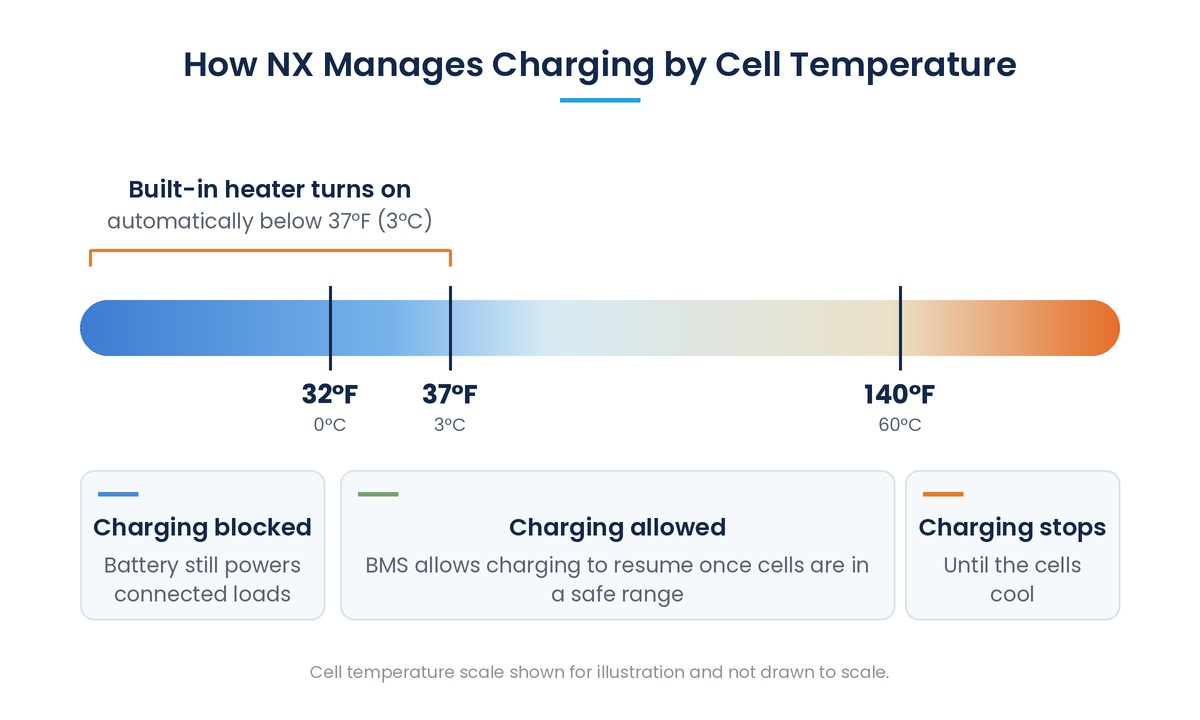
Cold-weather charging is a good example of the NX BMS at work. Lithium iron phosphate (LiFePO4) cells should not be charged below freezing. If a charger is connected and the NX BMS detects a cell temperature below 32°F (0°C), it blocks charging while the battery remains available to power connected loads. The built-in heating system turns on automatically below 37°F (3°C) to warm the cells. Once the cells return to a safe charging range, the BMS allows charging to resume without requiring action from the owner.
The BMS also monitors conditions at the other end of the temperature range. If cell temperature rises above 140°F (60°C), it stops charging until the cells cool. Owners don’t have to continuously monitor battery temperature or manually manage the charger as these conditions change. NX manages charging protection and allows charging to resume when conditions are appropriate.
The takeaway: NX continuously monitors operating conditions and helps manage battery performance through its integrated BMS.
The Muscle: How Does NX Manage High-Current Protection?
Modern electrical systems can place substantial demands on a battery, particularly when multiple devices operate at the same time. Meeting those demands requires more than the ability to deliver current. The battery must also manage that current and respond when operating conditions move outside its designed limits.
The NX12V310, the first model in the NX Series is rated for up to 300 amps of continuous discharge and 800 amps of peak output, supporting high-demand inverters and heavy electrical loads. In internal testing, the NX12V310 delivered sustained loads of 300A, 400A, and 500A, as well as peak loads up to 1,000A for five seconds, without damage. Maximum charge and discharge rates depend on ambient temperature and usage.
NX uses 175°C-rated MOSFET technology as part of its integrated electronic protection system. MOSFETs are electronic switches that control the flow of electricity. When the battery detects certain conditions outside its operating limits, its protection system can respond electronically. High-temperature-rated MOSFETs support the high-current switching requirements of the NX architecture.
The electronic protection system works alongside the BMS to help manage current and protect the battery during operation. NX incorporates both functions into a coordinated system, allowing monitoring and electronic protection to work together.
When electrical demand exceeds what the battery is designed to deliver, the BMS responds automatically. It continuously measures current, and if the current exceeds the configured limit, the BMS turns off the battery’s internal MOSFET switches. This interrupts output before the battery is pushed beyond its designed limits and alerts the user. In a short-circuit event, the BMS disconnects output when it detects the resulting voltage collapse.
Because this protection is built into the battery’s electronic switching, NX does not rely on an external circuit breaker for its own internal protection. Once the cause of the protection event has been corrected, output can be restored by pressing the power button.
For owners, this means the battery can interrupt power when necessary to protect itself and connected wiring and equipment from sustained overload. Power to connected equipment is interrupted during a protection event by design. Manufacturers and installers gain a battery designed to support high-current electrical demands while maintaining defined operating limits.
The takeaway: NX combines high-current capability with integrated electronic protection to help manage how power is delivered as electrical demands change.
The Connection: How Does NX Communicate With Other Equipment?
A battery is one part of a larger electrical system that may include an inverter, charger, solar equipment, or vehicle controls. As these systems become more sophisticated, communication between compatible components can provide better visibility into how the overall system is operating.
NX supports this communication through dual CAN connectivity. CAN, or Controller Area Network, is a communication technology that allows electronic components to exchange operating information. Through its CAN connections, NX can share battery information with compatible equipment and control systems.
NX uses RV-C, an open CAN-based communication standard widely used in recreational vehicles. On an RV-C network, NX broadcasts battery voltage, current, temperature, state of charge, state of health, and estimated time remaining. It also communicates its desired charging voltage and current to compatible chargers and inverter/chargers, allowing that equipment to adjust charging based on the battery’s needs rather than relying on fixed settings.
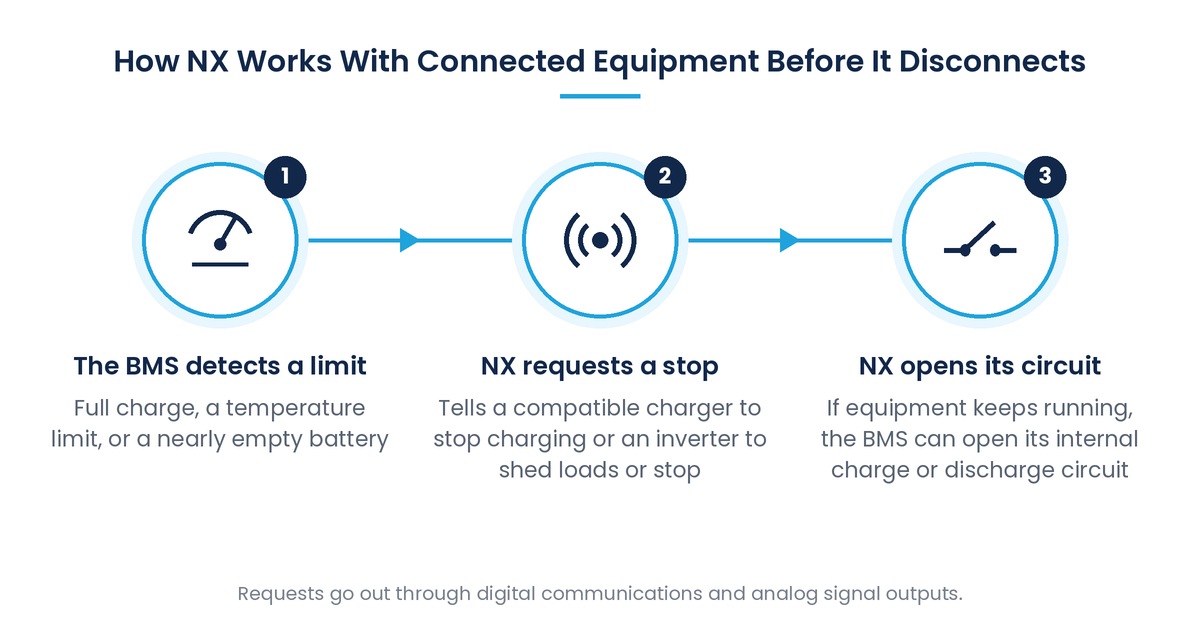
When the BMS needs to protect the battery, such as when it reaches full charge, approaches a temperature limit, or nears an empty state, it can first request that connected equipment stop charging or discharging. NX communicates these requests through both digital communications and analog signal outputs, directing a compatible charger to stop charging or an inverter to shed loads or stop.
If the connected equipment does not respond and continues operating, the BMS can open its internal charge or discharge circuit to protect the battery. This gives compatible equipment an opportunity to respond to the battery’s operating conditions before the battery disconnects the affected circuit.
NX’s second CAN port keeps the customer’s equipment network separate from the battery’s critical internal communication. This separation prevents third-party devices on the customer network from interfering with the battery’s internal protection functions.
The specific information exchanged and how it is used depend on the capabilities and configuration of the connected equipment. When supported, these communication functions allow charging and power equipment to respond to the battery’s operating conditions rather than operating without that information.
NX also includes Bluetooth connectivity, allowing owners and technicians to access battery information through the Lithionics mobile app. Users can view available operating information directly through the app rather than relying solely on external measurements or assumptions about battery conditions.
For manufacturers, these communication capabilities support integration with compatible electrical equipment. Owners and service technicians gain more direct access to battery information that can help with monitoring and troubleshooting.
The takeaway: Dual CAN communication and Bluetooth give compatible systems and users access to battery information, providing greater visibility into how the battery is operating.
How Battery Management, Protection, and Communication Work Together
Battery management, electronic protection, and communication serve different purposes within NX, but they are designed to operate together. The BMS continuously monitors conditions inside the battery, the electronic protection system helps manage current and respond to electrical faults, and CAN and Bluetooth communication make battery information available to compatible systems and users.
For owners, this means greater visibility into battery operation, with monitoring and protection functions built directly into the battery. Manufacturers and installers gain an integrated platform designed to work with increasingly sophisticated electrical systems.
The NX Series reflects Lithionics’ approach to battery development, bringing engineering, software, and electronic protection together in a single design. The platform is designed and engineered in the United States and built in Clearwater, Florida.
As power demands grow and electrical systems become more connected, the capabilities of a battery extend beyond how much energy it can store or deliver. How that energy is managed, protected, and communicated is becoming just as relevant to overall system performance.
Meet NX. More Than a Battery.


