
Tag: high-current lithium battery

Lithionics NX12V310 lithium battery

Inside NX: What Makes a Lithium Battery Truly Intelligent?

Your battery does more than deliver power. Here’s how the Lithionics NX Series manages, protects, and communicates within today’s electrical systems.

Think about everything that depends on reliable power.

On the water, it’s navigation equipment and critical onboard systems. On a job site, it’s the tools and equipment that keep work moving. In a specialty vehicle, it could be the technology and systems that need to operate reliably throughout the day. And in an RV, it’s everything that makes life on the road feel like home.

Different applications. Different demands. One common expectation: Power that performs when you need it.

As electrical systems become more sophisticated, the battery behind them needs to do more than store and deliver energy. It needs to monitor changing conditions, protect against electrical faults, and communicate with the equipment around it.

So what makes a lithium battery intelligent? Its ability to monitor and manage operating conditions, provide electronic protection, and share information with connected equipment.

The new Lithionics NX Series brings these capabilities together through three technologies:

  • The brain: An integrated Battery Management System (BMS) continuously monitors operating conditions and helps manage battery performance.
  • The muscle: 175°C-rated MOSFET electronic switching technology supports high-current operation and provides electronic protection.
  • The connection: Dual CAN communication and Bluetooth make battery information available to compatible equipment, owners, and technicians.

Each technology has a specific function, but they’re designed to work together as one integrated system.

Here’s what’s happening inside NX and why it matters for the people who depend on it.

The Brain: How Does the NX Battery Management System Work?

Electrical demands change throughout the day as equipment switches on and off, charging conditions vary, and temperatures fluctuate. A battery needs to operate within its designed limits as these conditions change. Managing those changes is the job of the Battery Management System, or BMS.

The BMS acts as the battery’s built-in control center. It continuously monitors key operating conditions, including voltage, current, and temperature, and helps manage how the battery operates.

In the NX Series, the BMS is integrated directly into the battery’s architecture and works alongside its electronic protection system. The BMS monitors operating conditions, while the protection system helps keep electrical operation within defined limits. Both functions are built into the battery and designed to work together.

For manufacturers and installers, this integrated approach supports system design by bringing monitoring and protection into a single battery platform. Owners benefit from having these functions built directly into the battery.

Cold-weather charging is a good example of the NX BMS at work. Lithium iron phosphate (LiFePO4) cells should not be charged below freezing. If a charger is connected and the NX BMS detects a cell temperature below 32°F (0°C), it blocks charging while the battery remains available to power connected loads. The built-in heating system turns on automatically below 37°F (3°C) to warm the cells. Once the cells return to a safe charging range, the BMS allows charging to resume without requiring action from the owner.

The BMS also monitors conditions at the other end of the temperature range. If cell temperature rises above 140°F (60°C), it stops charging until the cells cool. Owners don’t have to continuously monitor battery temperature or manually manage the charger as these conditions change. NX manages charging protection and allows charging to resume when conditions are appropriate.
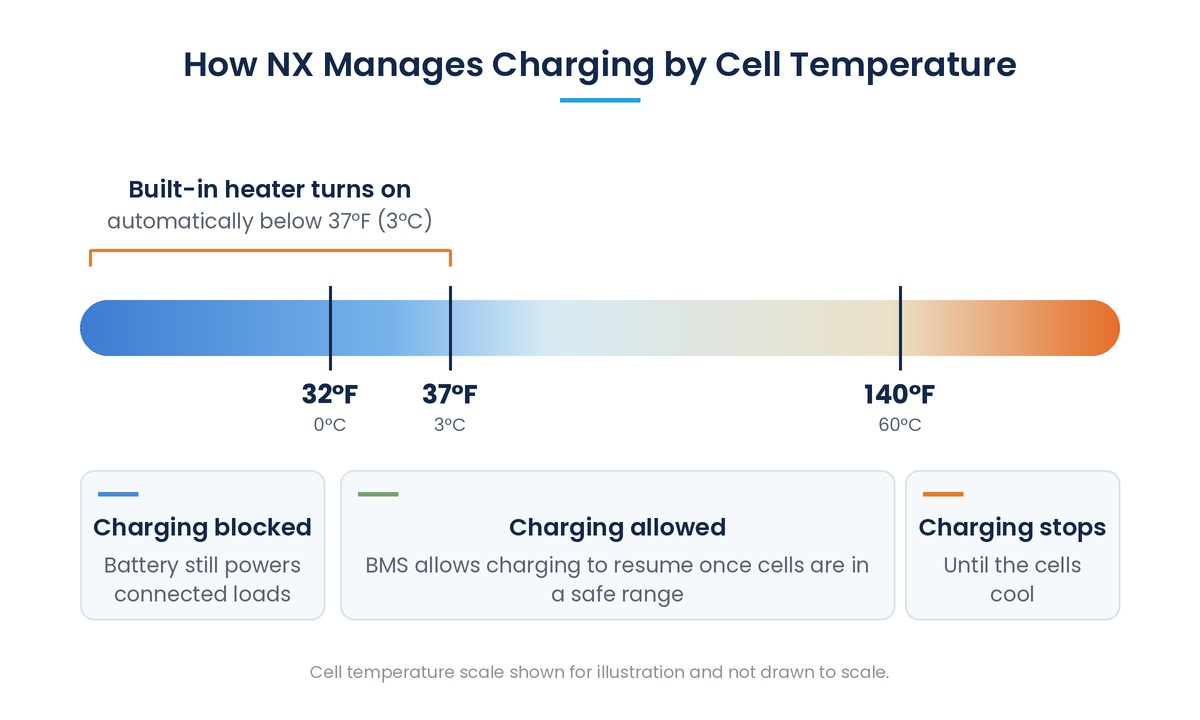
How NX manages charging by cell temperature: charging is blocked below 32°F (0°C), the built-in heater turns on below 37°F (3°C), and charging stops above 140°F (60°C) until the cells cool

The takeaway: NX continuously monitors operating conditions and helps manage battery performance through its integrated BMS.

The Muscle: How Does NX Manage High-Current Protection?

Modern electrical systems can place substantial demands on a battery, particularly when multiple devices operate at the same time. Meeting those demands requires more than the ability to deliver current. The battery must also manage that current and respond when operating conditions move outside its designed limits.

The NX12V310, the first model in the NX Series is rated for up to 300 amps of continuous discharge and 800 amps of peak output, supporting high-demand inverters and heavy electrical loads. In internal testing, the NX12V310 delivered sustained loads of 300A, 400A, and 500A, as well as peak loads up to 1,000A for five seconds, without damage. Maximum charge and discharge rates depend on ambient temperature and usage.

NX uses 175°C-rated MOSFET technology as part of its integrated electronic protection system. MOSFETs are electronic switches that control the flow of electricity. When the battery detects certain conditions outside its operating limits, its protection system can respond electronically. High-temperature-rated MOSFETs support the high-current switching requirements of the NX architecture.

The electronic protection system works alongside the BMS to help manage current and protect the battery during operation. NX incorporates both functions into a coordinated system, allowing monitoring and electronic protection to work together.

When electrical demand exceeds what the battery is designed to deliver, the BMS responds automatically. It continuously measures current, and if the current exceeds the configured limit, the BMS turns off the battery’s internal MOSFET switches. This interrupts output before the battery is pushed beyond its designed limits and alerts the user. In a short-circuit event, the BMS disconnects output when it detects the resulting voltage collapse.

Because this protection is built into the battery’s electronic switching, NX does not rely on an external circuit breaker for its own internal protection. Once the cause of the protection event has been corrected, output can be restored by pressing the power button.

For owners, this means the battery can interrupt power when necessary to protect itself and connected wiring and equipment from sustained overload. Power to connected equipment is interrupted during a protection event by design. Manufacturers and installers gain a battery designed to support high-current electrical demands while maintaining defined operating limits.

The takeaway: NX combines high-current capability with integrated electronic protection to help manage how power is delivered as electrical demands change.

The Connection: How Does NX Communicate With Other Equipment?

A battery is one part of a larger electrical system that may include an inverter, charger, solar equipment, or vehicle controls. As these systems become more sophisticated, communication between compatible components can provide better visibility into how the overall system is operating.

NX supports this communication through dual CAN connectivity. CAN, or Controller Area Network, is a communication technology that allows electronic components to exchange operating information. Through its CAN connections, NX can share battery information with compatible equipment and control systems.

NX uses RV-C, an open CAN-based communication standard widely used in recreational vehicles. On an RV-C network, NX broadcasts battery voltage, current, temperature, state of charge, state of health, and estimated time remaining. It also communicates its desired charging voltage and current to compatible chargers and inverter/chargers, allowing that equipment to adjust charging based on the battery’s needs rather than relying on fixed settings.

When the BMS needs to protect the battery, such as when it reaches full charge, approaches a temperature limit, or nears an empty state, it can first request that connected equipment stop charging or discharging. NX communicates these requests through both digital communications and analog signal outputs, directing a compatible charger to stop charging or an inverter to shed loads or stop.

If the connected equipment does not respond and continues operating, the BMS can open its internal charge or discharge circuit to protect the battery. This gives compatible equipment an opportunity to respond to the battery’s operating conditions before the battery disconnects the affected circuit.
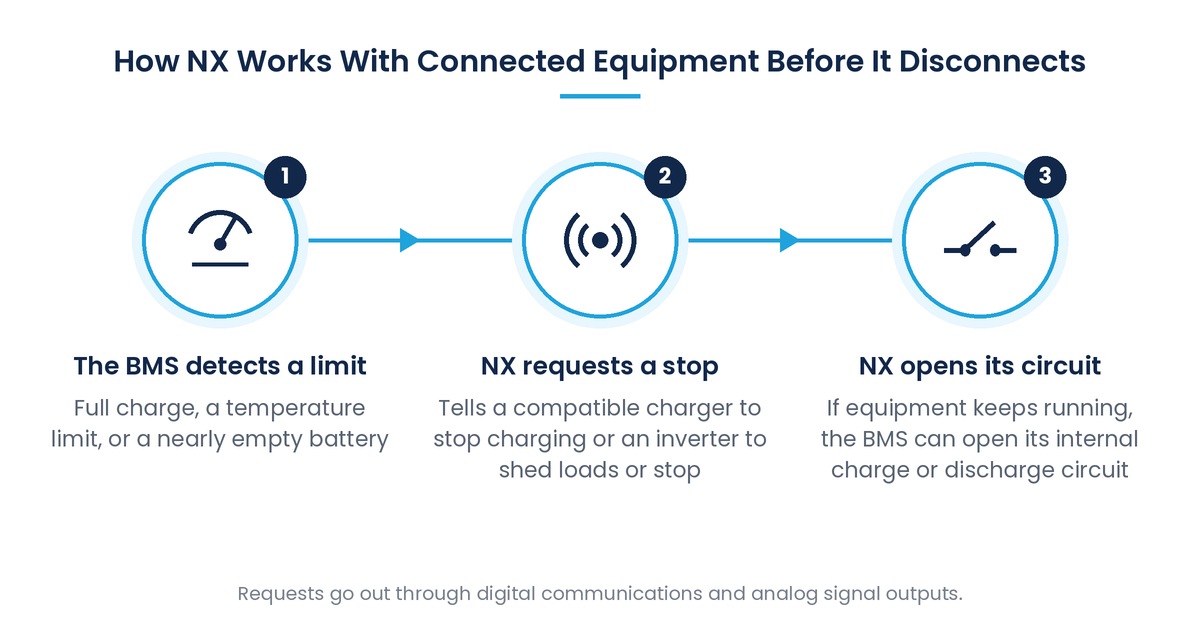
How NX works with connected equipment before it disconnects: the BMS detects a limit, NX requests a stop from the charger or inverter, then NX opens its internal charge or discharge circuit if equipment keeps running

NX’s second CAN port keeps the customer’s equipment network separate from the battery’s critical internal communication. This separation prevents third-party devices on the customer network from interfering with the battery’s internal protection functions.

The specific information exchanged and how it is used depend on the capabilities and configuration of the connected equipment. When supported, these communication functions allow charging and power equipment to respond to the battery’s operating conditions rather than operating without that information.

NX also includes Bluetooth connectivity, allowing owners and technicians to access battery information through the Lithionics mobile app. Users can view available operating information directly through the app rather than relying solely on external measurements or assumptions about battery conditions.

For manufacturers, these communication capabilities support integration with compatible electrical equipment. Owners and service technicians gain more direct access to battery information that can help with monitoring and troubleshooting.

The takeaway: Dual CAN communication and Bluetooth give compatible systems and users access to battery information, providing greater visibility into how the battery is operating.

How Battery Management, Protection, and Communication Work Together

Battery management, electronic protection, and communication serve different purposes within NX, but they are designed to operate together. The BMS continuously monitors conditions inside the battery, the electronic protection system helps manage current and respond to electrical faults, and CAN and Bluetooth communication make battery information available to compatible systems and users.

For owners, this means greater visibility into battery operation, with monitoring and protection functions built directly into the battery. Manufacturers and installers gain an integrated platform designed to work with increasingly sophisticated electrical systems.

The NX Series reflects Lithionics’ approach to battery development, bringing engineering, software, and electronic protection together in a single design. The platform is designed and engineered in the United States and built in Clearwater, Florida.

As power demands grow and electrical systems become more connected, the capabilities of a battery extend beyond how much energy it can store or deliver. How that energy is managed, protected, and communicated is becoming just as relevant to overall system performance.

Meet NX. More Than a Battery.

Explore the NX Series

Related Articles
Lithionics NX Series 12V 310Ah intelligent lithium battery

Introducing the NX Series: The Next Generation of Intelligent Lithium Batteries

More Than a Battery. A Smarter Way to Power What’s Next.

Today’s RVs, boats and specialty vehicles are doing more than ever, and their electrical systems need to keep up. From everyday comforts to demanding onboard equipment, intelligent lithium batteries are helping deliver the reliable power these applications depend on.

But as power demands grow, batteries need to do more than simply store energy. They need to deliver more power, communicate with other equipment and help protect the systems that depend on them.

That’s what we’ve been working toward at Lithionics Battery.

Introducing the NX Series, our next generation of intelligent lithium batteries, designed to deliver more power, smarter protection and greater control.

NX brings together higher current capability, an advanced battery management system (BMS), integrated protection and smarter connectivity. It’s a major step forward in how we design, manage and deliver power.

And this launch is bigger than one battery. NX introduces an entirely new platform, built to support what’s next.

Intelligent Lithium Batteries: One New Platform. A Whole New Direction.

Think of NX like a vehicle platform that can support several different models. The underlying engineering stays consistent, while the design can evolve to meet different needs.

We’re taking a similar approach with NX.

Rather than starting from scratch with every new battery, we’ve developed a common architecture that can support different battery sizes, configurations and applications.

That gives our engineering team more room to innovate while providing customers with a platform built for the future.

But what really makes NX different is what’s happening inside.

Here are some of the biggest advancements:

  • 300 amps of continuous output: More power available for demanding electrical systems, including larger inverters and high-current equipment.
  • Built-in intelligence and protection: An advanced BMS monitors battery conditions and manages protection without relying on separate external BMS components.
  • Advanced electronics: 175°C-rated MOSFET switching and electronic protection features built for demanding electrical environments.
  • Smarter communication: Dual CAN communication and Bluetooth monitoring help the battery communicate with other equipment and provide useful information to users.
  • Room to grow: A flexible design that gives Lithionics a foundation for future batteries and new capabilities.

These aren’t simply upgrades to a list of specifications. They show how intelligent lithium batteries can do more than store energy, helping manage power and work more effectively within the larger electrical system.

300 Amps. What Does That Actually Mean?

More appliances. Larger inverters. More equipment running on battery power.

Whether it’s an RV, a boat or a specialty vehicle, electrical demands are growing.

The first battery in the NX family, the NX12V310, delivers 4.0 kWh of stored energy and up to 300 amps of continuous output.

That means the battery can deliver a high level of current continuously within its operating limits, not just for a few seconds.

Think about an RV running several appliances or a boat powering demanding onboard equipment. The battery needs to do more than hold enough energy. It also needs to deliver that energy at the rate the equipment requires.

That’s where NX’s high-current capability makes a difference.

For manufacturers and system designers, it means greater flexibility to build power systems around demanding electrical loads, provided the rest of the system is properly sized.

Because it’s not just about how much power you have. It’s about having the power available when you need it.

The Brain Behind the Power: A Smarter Battery Management System

Here’s something people don’t always realize about lithium batteries: the cells are only part of the story. Think of the battery cells as the muscles and the battery management system (BMS) as the brain.

The cells store and deliver energy. The BMS monitors what’s happening inside the battery, tracking important conditions like voltage, current and temperature. When conditions change, the BMS helps determine how the battery should respond to protect itself.

That’s what makes intelligent lithium batteries different from simple energy storage.

With NX, we’ve taken that intelligence further.

Our new integrated BMS incorporates 175°C-rated MOSFET switching, electronic controls and communication capabilities built for high-current applications.

And because the BMS and circuit protection are built into the battery, system designers don’t need to rely on a separate external BMS for those functions.

The benefit? Powerful battery performance with intelligent monitoring and protection working together inside one system.

The battery doesn’t just deliver power. It helps manage it.

Safer by Design. Ready for the Unexpected.

Electrical systems don’t always behave exactly as expected.

Equipment turns on and off. Loads change. And sometimes, sudden spikes in voltage can put stress on sensitive electronics.

Here’s a simple way to think about it.

Imagine water flowing steadily through a pipe. Everything works as expected until a sudden surge in pressure puts extra stress on the system.

Electricity can behave in a similar way.

These sudden voltage spikes are called transients, and they’re an important consideration when designing reliable electrical systems.

NX incorporates advanced electronic protection features designed to help its internal electronics withstand demanding electrical conditions.

But safety doesn’t stop with the electronics.

NX builds on Lithionics’ established approach to battery safety, combining lithium iron phosphate (LiFePO4) chemistry, rugged aluminum enclosures, intelligent monitoring and system-level engineering.

The NX12V310 is also UL 1973 certified, meaning the battery has been evaluated against an established safety standard for battery systems. UL 1973 addresses safety requirements for batteries used in applications including stationary energy storage and vehicle auxiliary power.

Because real battery safety isn’t about one component or one feature. It’s about how everything works together.

Smarter Connections. Easier Integration.

A modern power system is made up of more than a battery.

There are inverters, chargers, vehicle controls, monitoring systems and other components that all need to work together.

And the more capable these systems become, the more important communication becomes.

NX was developed with that in mind.

With dual CAN communication capabilities, NX can exchange information with compatible equipment, helping manufacturers and integrators build more connected electrical systems.

It also includes Bluetooth connectivity through the Lithionics Battery Monitor app.

That means users can check important battery information, including state of charge and available diagnostic information, without guessing what’s happening inside.

For installers and technical support teams, that visibility can also make it easier to understand battery conditions and troubleshoot issues.

As intelligent lithium batteries become more connected, that visibility helps users, installers and manufacturers better understand how their electrical systems are performing.

Smarter communication. Better visibility. Less guesswork.

That’s the direction we’re taking with NX.

Built for RV, Marine and Specialty Vehicle Power Systems

No two applications are exactly alike.

An RV may need dependable power for air conditioning, appliances and onboard technology. A boat may rely on its house battery system for electronics, lighting and equipment. A specialty vehicle may need reliable energy to operate tools or other essential systems.

The applications are different, but the challenge is familiar: delivering dependable power while keeping the system safe, manageable and reliable.

The NX Series was developed to support a wide range of applications:

  • RV power systems: High-current capability for demanding onboard electrical systems and inverter-based applications.
  • Marine power systems: Dependable house power for onboard electronics, equipment and accessories.
  • Specialty and commercial vehicles: Reliable energy for auxiliary electrical systems, equipment and specialized applications.
  • Custom power solutions: A flexible platform for unique electrical requirements and specialized system designs.

For OEMs, system designers and authorized installers, NX provides another way to meet growing power demands without losing sight of safety, performance or control.

One Platform. A Lot More to Come.

The NX12V310 is just the beginning.

The NX Series was developed as a family of batteries, not a single product.

By building on a common architecture, our engineering team can continue developing new configurations and capabilities as customer needs change.

That matters because electrical systems aren’t standing still. Power demands will continue to grow, equipment will become more connected and customers will expect more from their batteries.

We’re building NX with that future in mind, creating a foundation for the next generation of intelligent lithium batteries and the systems they’ll power.

And with battery engineering, electronics, software development and manufacturing expertise at Lithionics, we’re excited about what’s ahead.

Frequently Asked Questions About NX Series

What is an intelligent lithium battery?

An intelligent lithium battery does more than store energy. It includes a battery management system that monitors conditions, manages protection and provides information about how the battery is operating.

What makes the Lithionics NX Series different?

NX combines high-current performance, an advanced integrated BMS, electronic protection and smarter connectivity in a new battery platform. The first model, NX12V310, delivers 4.0 kWh of stored energy and up to 300 amps of continuous output.

Can the NX Series be used in RVs and boats?

Yes. NX Series is designed for demanding applications including RV and marine house power systems, as well as specialty vehicles and custom applications. The right battery and system configuration depend on the application’s electrical requirements. Installation must be performed by an authorized professional.

What does an integrated battery management system do?

An integrated BMS monitors battery conditions and manages protective functions. By building these capabilities into the battery, NX can simplify system design and reduce the need for certain external components.

More Than a Battery. Just the Beginning.

NX represents a major step forward for Lithionics, bringing together years of battery engineering experience with a new generation of electronics, intelligent controls and high-current performance.

And the NX12V310 is only the beginning.

We’ve built this platform to support new battery configurations, emerging technologies and evolving power demands.

Over the coming weeks, we’ll take a closer look at the engineering behind NX, from its advanced battery management system and high-current capabilities to the protection and communication features that make it different.

Because NX is more than a new battery. It’s the foundation for what’s next in intelligent power.

Explore the NX12V310 Battery →