
Tag: Intelligent Lithium Batteries

Lithionics NX12V310 lithium battery

Inside NX: What Makes a Lithium Battery Truly Intelligent?

Your battery does more than deliver power. Here’s how the Lithionics NX Series manages, protects, and communicates within today’s electrical systems.

Think about everything that depends on reliable power.

On the water, it’s navigation equipment and critical onboard systems. On a job site, it’s the tools and equipment that keep work moving. In a specialty vehicle, it could be the technology and systems that need to operate reliably throughout the day. And in an RV, it’s everything that makes life on the road feel like home.

Different applications. Different demands. One common expectation: Power that performs when you need it.

As electrical systems become more sophisticated, the battery behind them needs to do more than store and deliver energy. It needs to monitor changing conditions, protect against electrical faults, and communicate with the equipment around it.

So what makes a lithium battery intelligent? Its ability to monitor and manage operating conditions, provide electronic protection, and share information with connected equipment.

The new Lithionics NX Series brings these capabilities together through three technologies:

  • The brain: An integrated Battery Management System (BMS) continuously monitors operating conditions and helps manage battery performance.
  • The muscle: 175°C-rated MOSFET electronic switching technology supports high-current operation and provides electronic protection.
  • The connection: Dual CAN communication and Bluetooth make battery information available to compatible equipment, owners, and technicians.

Each technology has a specific function, but they’re designed to work together as one integrated system.

Here’s what’s happening inside NX and why it matters for the people who depend on it.

The Brain: How Does the NX Battery Management System Work?

Electrical demands change throughout the day as equipment switches on and off, charging conditions vary, and temperatures fluctuate. A battery needs to operate within its designed limits as these conditions change. Managing those changes is the job of the Battery Management System, or BMS.

The BMS acts as the battery’s built-in control center. It continuously monitors key operating conditions, including voltage, current, and temperature, and helps manage how the battery operates.

In the NX Series, the BMS is integrated directly into the battery’s architecture and works alongside its electronic protection system. The BMS monitors operating conditions, while the protection system helps keep electrical operation within defined limits. Both functions are built into the battery and designed to work together.

For manufacturers and installers, this integrated approach supports system design by bringing monitoring and protection into a single battery platform. Owners benefit from having these functions built directly into the battery.

Cold-weather charging is a good example of the NX BMS at work. Lithium iron phosphate (LiFePO4) cells should not be charged below freezing. If a charger is connected and the NX BMS detects a cell temperature below 32°F (0°C), it blocks charging while the battery remains available to power connected loads. The built-in heating system turns on automatically below 37°F (3°C) to warm the cells. Once the cells return to a safe charging range, the BMS allows charging to resume without requiring action from the owner.

The BMS also monitors conditions at the other end of the temperature range. If cell temperature rises above 140°F (60°C), it stops charging until the cells cool. Owners don’t have to continuously monitor battery temperature or manually manage the charger as these conditions change. NX manages charging protection and allows charging to resume when conditions are appropriate.
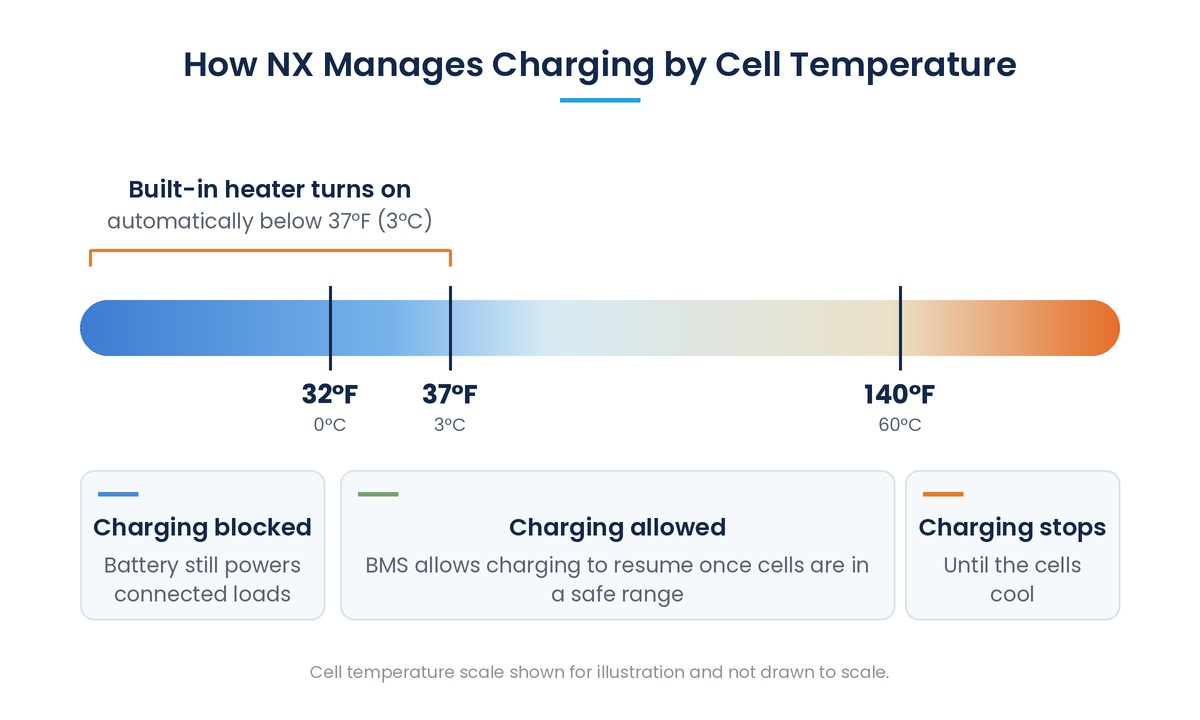
How NX manages charging by cell temperature: charging is blocked below 32°F (0°C), the built-in heater turns on below 37°F (3°C), and charging stops above 140°F (60°C) until the cells cool

The takeaway: NX continuously monitors operating conditions and helps manage battery performance through its integrated BMS.

The Muscle: How Does NX Manage High-Current Protection?

Modern electrical systems can place substantial demands on a battery, particularly when multiple devices operate at the same time. Meeting those demands requires more than the ability to deliver current. The battery must also manage that current and respond when operating conditions move outside its designed limits.

The NX12V310, the first model in the NX Series is rated for up to 300 amps of continuous discharge and 800 amps of peak output, supporting high-demand inverters and heavy electrical loads. In internal testing, the NX12V310 delivered sustained loads of 300A, 400A, and 500A, as well as peak loads up to 1,000A for five seconds, without damage. Maximum charge and discharge rates depend on ambient temperature and usage.

NX uses 175°C-rated MOSFET technology as part of its integrated electronic protection system. MOSFETs are electronic switches that control the flow of electricity. When the battery detects certain conditions outside its operating limits, its protection system can respond electronically. High-temperature-rated MOSFETs support the high-current switching requirements of the NX architecture.

The electronic protection system works alongside the BMS to help manage current and protect the battery during operation. NX incorporates both functions into a coordinated system, allowing monitoring and electronic protection to work together.

When electrical demand exceeds what the battery is designed to deliver, the BMS responds automatically. It continuously measures current, and if the current exceeds the configured limit, the BMS turns off the battery’s internal MOSFET switches. This interrupts output before the battery is pushed beyond its designed limits and alerts the user. In a short-circuit event, the BMS disconnects output when it detects the resulting voltage collapse.

Because this protection is built into the battery’s electronic switching, NX does not rely on an external circuit breaker for its own internal protection. Once the cause of the protection event has been corrected, output can be restored by pressing the power button.

For owners, this means the battery can interrupt power when necessary to protect itself and connected wiring and equipment from sustained overload. Power to connected equipment is interrupted during a protection event by design. Manufacturers and installers gain a battery designed to support high-current electrical demands while maintaining defined operating limits.

The takeaway: NX combines high-current capability with integrated electronic protection to help manage how power is delivered as electrical demands change.

The Connection: How Does NX Communicate With Other Equipment?

A battery is one part of a larger electrical system that may include an inverter, charger, solar equipment, or vehicle controls. As these systems become more sophisticated, communication between compatible components can provide better visibility into how the overall system is operating.

NX supports this communication through dual CAN connectivity. CAN, or Controller Area Network, is a communication technology that allows electronic components to exchange operating information. Through its CAN connections, NX can share battery information with compatible equipment and control systems.

NX uses RV-C, an open CAN-based communication standard widely used in recreational vehicles. On an RV-C network, NX broadcasts battery voltage, current, temperature, state of charge, state of health, and estimated time remaining. It also communicates its desired charging voltage and current to compatible chargers and inverter/chargers, allowing that equipment to adjust charging based on the battery’s needs rather than relying on fixed settings.

When the BMS needs to protect the battery, such as when it reaches full charge, approaches a temperature limit, or nears an empty state, it can first request that connected equipment stop charging or discharging. NX communicates these requests through both digital communications and analog signal outputs, directing a compatible charger to stop charging or an inverter to shed loads or stop.

If the connected equipment does not respond and continues operating, the BMS can open its internal charge or discharge circuit to protect the battery. This gives compatible equipment an opportunity to respond to the battery’s operating conditions before the battery disconnects the affected circuit.
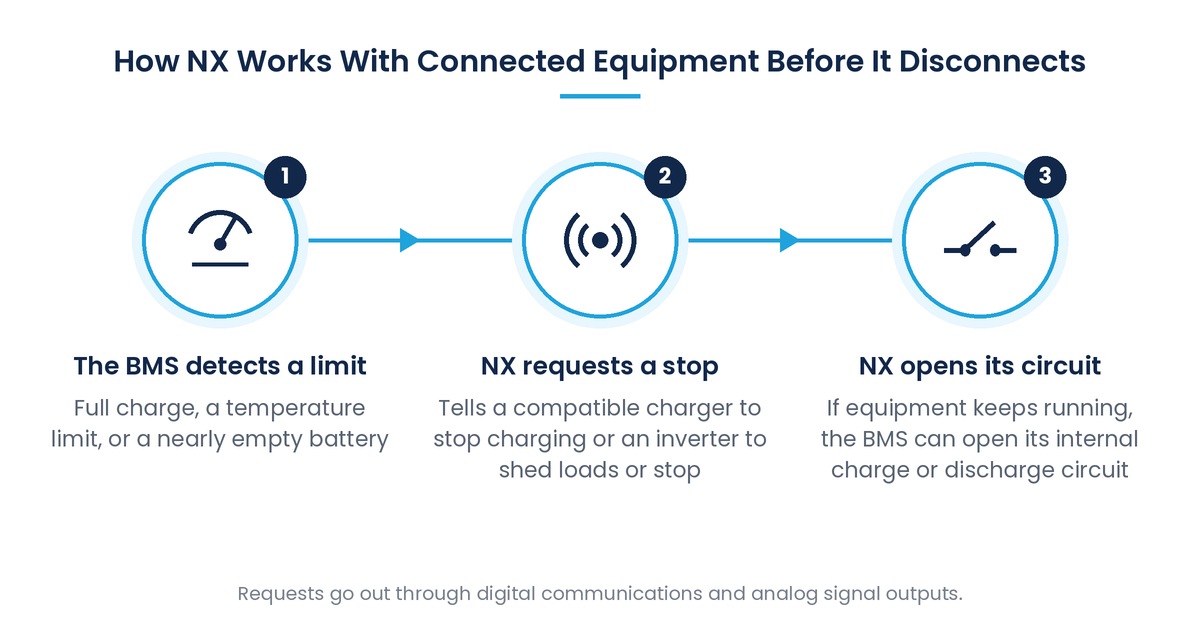
How NX works with connected equipment before it disconnects: the BMS detects a limit, NX requests a stop from the charger or inverter, then NX opens its internal charge or discharge circuit if equipment keeps running

NX’s second CAN port keeps the customer’s equipment network separate from the battery’s critical internal communication. This separation prevents third-party devices on the customer network from interfering with the battery’s internal protection functions.

The specific information exchanged and how it is used depend on the capabilities and configuration of the connected equipment. When supported, these communication functions allow charging and power equipment to respond to the battery’s operating conditions rather than operating without that information.

NX also includes Bluetooth connectivity, allowing owners and technicians to access battery information through the Lithionics mobile app. Users can view available operating information directly through the app rather than relying solely on external measurements or assumptions about battery conditions.

For manufacturers, these communication capabilities support integration with compatible electrical equipment. Owners and service technicians gain more direct access to battery information that can help with monitoring and troubleshooting.

The takeaway: Dual CAN communication and Bluetooth give compatible systems and users access to battery information, providing greater visibility into how the battery is operating.

How Battery Management, Protection, and Communication Work Together

Battery management, electronic protection, and communication serve different purposes within NX, but they are designed to operate together. The BMS continuously monitors conditions inside the battery, the electronic protection system helps manage current and respond to electrical faults, and CAN and Bluetooth communication make battery information available to compatible systems and users.

For owners, this means greater visibility into battery operation, with monitoring and protection functions built directly into the battery. Manufacturers and installers gain an integrated platform designed to work with increasingly sophisticated electrical systems.

The NX Series reflects Lithionics’ approach to battery development, bringing engineering, software, and electronic protection together in a single design. The platform is designed and engineered in the United States and built in Clearwater, Florida.

As power demands grow and electrical systems become more connected, the capabilities of a battery extend beyond how much energy it can store or deliver. How that energy is managed, protected, and communicated is becoming just as relevant to overall system performance.

Meet NX. More Than a Battery.

Explore the NX Series

Related Articles
Lithionics Smart Alternator Series designed to support reliable lithium battery charging in RVs

Managing Energy, Not Just Charging Batteries: A Better Approach to Alternator Charging

RVs are asking more from their electrical systems than ever before. As lithium battery banks get larger and customers expect to power more onboard, RV alternator charging is becoming an increasingly important part of keeping up with that demand.

That is where alternator charging can play a bigger role. A well-designed system can put meaningful energy back into the batteries while driving, helping owners rely less on a generator and arrive with more power available. In some higher-power applications, it may even reduce the need for a separate generator.

But generating more power is only part of the story. The bigger challenge is making sure the entire system can safely and reliably handle it.

Lithium batteries can accept a lot of energy for a long time. That is a major advantage, but it can also keep an alternator working harder for longer. Heat, wiring, controls, the battery management system (BMS) and communication between components all come into play. Simply adding a larger alternator does not necessarily create a better charging system.

Everything has to work together. The system needs to manage how much power the battery receives, adjust as temperatures and charging needs change, and respond safely if something goes wrong.

For RV manufacturers, that changes the question from “How big is the alternator?” to “How do we manage energy across the entire vehicle?”

Why Lithium Changes the Conversation

Traditional lead-acid batteries naturally reduce the amount of current they accept as they charge. Lithium batteries behave differently.

A large lithium battery bank can continue accepting high current through much of its charging cycle. That is one of lithium’s advantages because it allows energy to be replenished quickly. But it also means the charging source may be asked to work hard for a much longer period.

An alternator that can briefly produce a high current is not necessarily capable of sustaining that output for an hour or more in a hot engine compartment.

This becomes particularly important at idle or low engine speeds. Electrical demand can remain high while alternator cooling airflow decreases. A large lithium bank may still be asking for significant charging power, even though the alternator is operating under some of its toughest thermal conditions.

That is why the number printed on an alternator should not be confused with the amount of power actually available for continuous battery charging.

The real question is how much output the alternator can reliably provide when it is hot, installed in the vehicle and operating under real-world conditions.

The OEM Alternator Has a Day Job

Using the vehicle’s factory alternator to charge the house battery can be attractive. The alternator is already there, so the approach can be relatively simple and cost-effective.

The challenge is that the OEM alternator was not installed solely for the house battery.

It also has to support the engine controls, lighting, HVAC, fans, emissions equipment, safety systems, starting-battery recovery and other chassis electrical loads. Those systems have priority.

So a 200-amp alternator does not necessarily mean an RV manufacturer has 200 amps available for house-battery charging.

One common way to manage that is through a properly sized DC-DC charger. Instead of allowing the lithium battery to pull whatever current the system will provide, the DC-DC charger creates a controlled limit on demand.

But even then, sizing matters. The charger should match the alternator capacity available after accounting for the vehicle’s other electrical requirements, particularly under hot operating conditions.

For higher-power applications, a dedicated secondary alternator offers another path. Because it is intended primarily for the house electrical system, it can provide substantially more charging power without consuming the OEM alternator’s allocation.

That can be a major advantage, but it also introduces more engineering considerations, including belts, pulleys, brackets, heat, wiring, regulation, communication and protection.

In other words, more available power also means more responsibility for managing it.

Think Beyond the Alternator

More charging power also means more heat and more demand on the components around the alternator. That is why simply choosing a larger alternator is not enough.

Take heat. When an alternator works hard for a long period of time, temperatures rise. Instead of running at full power until the system gets too hot and shuts down, a well-designed system can automatically reduce charging when temperatures climb, then increase it again as things cool down.

For the owner, that might mean charging a little more slowly for a period of time rather than unexpectedly losing charging altogether.

There is a mechanical side to consider, too. Higher alternator output puts more demand on belts, pulleys, brackets and other components connected to the engine. Those parts need to handle that load over time, not just during a short test.

The takeaway is simple: More power is only useful if the rest of the vehicle is designed to handle it.

The BMS Should Be the Last Line of Defense

One of the most important principles in a high-power lithium charging system is also pretty simple: the battery should not have to disconnect itself every time charging needs to stop.

The battery management system (BMS) is there to protect the battery. If voltage or temperature reaches an unsafe level, it can stop charging or disconnect the battery when necessary.

For a closer look at how battery management, system integration and protection work together, read Lithionics: Safety That Goes Beyond the Standard.

But ideally, the charging system responds before it gets to that point.

Why does that matter? An alternator producing a lot of power cannot always stop instantly. If the battery suddenly disconnects while the alternator is still producing energy, that energy has to go somewhere. The result can be a sudden spike in voltage, known as a load dump, that can put stress on other components in the system.

A better approach is to gradually reduce charging as the battery approaches its limits. If charging needs to stop, alternator output comes down first. The BMS is still there as a final layer of protection if something goes wrong.

The takeaway: The system should manage the energy before the battery has to step in and protect itself.

Communication Is Useful, but It Needs a Backup Plan

Modern RV electrical systems increasingly use CAN or RV-C networks so batteries, charging sources, inverters and vehicle controllers can exchange information.

That allows the BMS to communicate things such as allowable charging current, temperature conditions and whether charging should continue.

But communication alone is not enough. A system also has to know what to do if a message is delayed, incorrect or disappears entirely.

If the BMS stops communicating its charging limits, the charging system should not continue operating at full power until the battery disconnects.

The preferred response is to move toward a known, limited state or stop charging in a controlled way. In higher-power systems, an independent hardwired shutdown path can provide another layer of protection if network communication is lost.

The principle is straightforward: no single component or communication path should carry all of the responsibility for keeping the system safe.

Choosing the Right RV Alternator Charging System

As RV electrical demands grow, OEMs have several ways to approach alternator charging.

Direct charging from the OEM alternator offers simplicity, but the available capacity and protection strategy have to be thoroughly understood. A DC-DC charger can create a useful controlled boundary. A dedicated secondary alternator can provide substantially more charging power. Newer inverter-based smart-generator architectures can add even greater control over how power is generated and managed.

For applications requiring dedicated charging power, explore the Lithionics Smart Alternator Series and how inverter-based technology supports lithium battery charging.

There is no single architecture that fits every vehicle.

What matters is whether the components work together as a complete, validated system.

A purpose-built system has an advantage because the battery limits, charging source, controls, thermal behavior, communication, shutdown strategy and diagnostics can be designed around one another from the beginning.

That can allow the system to harvest more useful energy while also responding more intelligently when conditions change.

Instead of waiting for a protective limit to be reached, the system can reduce output. When temperatures rise, it can derate rather than simply shutting down. And rather than leaving a technician with a generic “not charging” complaint, it can provide information that helps explain what happened.

That last piece matters more than it may seem.

Design for the Technician, Too

A charging system is not truly ready for production just because it works during development. Eventually, somebody has to diagnose it.

An owner may report that the RV is “not charging,” but that symptom could come from an overheated alternator, a BMS protection event, a communication problem, excessive wiring voltage drop, a blown fuse, a configuration change or a mechanical issue.

Without useful diagnostics, the service process can quickly become component swapping.

A production-ready system should preserve information about battery conditions, charging output, temperatures, communication health and fault events so technicians can narrow down the actual cause.

Commissioning matters for the same reason. The configuration that was validated by engineering needs to be the configuration that reaches the customer. Voltage limits, current limits, temperature settings, firmware and recovery behavior all need to be controlled and documented.

Validate the Vehicle, Not Just the Components

Perhaps the biggest takeaway for OEMs is that component specifications only tell part of the story.

A battery can be properly engineered. So can an alternator, regulator and inverter. That does not automatically mean they will behave correctly when connected together in a specific vehicle.

Validation needs to reflect the installed application.

That means testing at low battery state of charge, when charging demand may be highest. It means hot ambient temperatures, idle operation, normal chassis electrical loads, communication failures, charging shutdowns and recovery. It also means validating the mechanical drive and what happens during abnormal events.

RV manufacturers also need to account for applicable industry requirements, including the electrical standards outlined by the RV Industry Association.

Changes matter, too.

A different alternator, battery, regulator, cable route, firmware version or charging profile can change system behavior and may require additional validation.

Bringing It All Together

Alternator charging can make a big difference in how capable a lithium-equipped RV can be. It can recharge batteries while driving, reduce generator use and give owners more usable power when they arrive.

But the real opportunity is not simply adding a bigger alternator. It is designing the battery, charging source, controls and vehicle to work together.

For OEMs, there are a few key things to keep in mind: know how much power is actually available, manage heat and charging before limits are reached, build in layers of protection, and test the system as it will actually be used.

When those pieces work together, the result is not just more charging power. It is a smarter, more reliable way to manage energy across the vehicle.

That is the shift: from simply charging batteries to managing energy.

Learn more about Lithionics lithium battery solutions for RVs and vans and how integrated power systems support today’s electrical demands.