Tag: lithionics

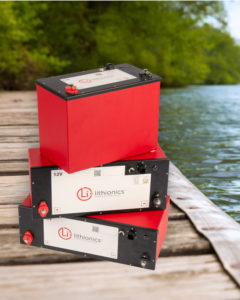
Lithionics NX12V310 lithium battery

Inside NX: What Makes a Lithium Battery Truly Intelligent?

Your battery does more than deliver power. Here’s how the Lithionics NX Series manages, protects, and communicates within today’s electrical systems.

Think about everything that depends on reliable power.

On the water, it’s navigation equipment and critical onboard systems. On a job site, it’s the tools and equipment that keep work moving. In a specialty vehicle, it could be the technology and systems that need to operate reliably throughout the day. And in an RV, it’s everything that makes life on the road feel like home.

Different applications. Different demands. One common expectation: Power that performs when you need it.

As electrical systems become more sophisticated, the battery behind them needs to do more than store and deliver energy. It needs to monitor changing conditions, protect against electrical faults, and communicate with the equipment around it.

So what makes a lithium battery intelligent? Its ability to monitor and manage operating conditions, provide electronic protection, and share information with connected equipment.

The new Lithionics NX Series brings these capabilities together through three technologies:

  • The brain: An integrated Battery Management System (BMS) continuously monitors operating conditions and helps manage battery performance.
  • The muscle: 175°C-rated MOSFET electronic switching technology supports high-current operation and provides electronic protection.
  • The connection: Dual CAN communication and Bluetooth make battery information available to compatible equipment, owners, and technicians.

Each technology has a specific function, but they’re designed to work together as one integrated system.

Here’s what’s happening inside NX and why it matters for the people who depend on it.

The Brain: How Does the NX Battery Management System Work?

Electrical demands change throughout the day as equipment switches on and off, charging conditions vary, and temperatures fluctuate. A battery needs to operate within its designed limits as these conditions change. Managing those changes is the job of the Battery Management System, or BMS.

The BMS acts as the battery’s built-in control center. It continuously monitors key operating conditions, including voltage, current, and temperature, and helps manage how the battery operates.

In the NX Series, the BMS is integrated directly into the battery’s architecture and works alongside its electronic protection system. The BMS monitors operating conditions, while the protection system helps keep electrical operation within defined limits. Both functions are built into the battery and designed to work together.

For manufacturers and installers, this integrated approach supports system design by bringing monitoring and protection into a single battery platform. Owners benefit from having these functions built directly into the battery.

Cold-weather charging is a good example of the NX BMS at work. Lithium iron phosphate (LiFePO4) cells should not be charged below freezing. If a charger is connected and the NX BMS detects a cell temperature below 32°F (0°C), it blocks charging while the battery remains available to power connected loads. The built-in heating system turns on automatically below 37°F (3°C) to warm the cells. Once the cells return to a safe charging range, the BMS allows charging to resume without requiring action from the owner.

The BMS also monitors conditions at the other end of the temperature range. If cell temperature rises above 140°F (60°C), it stops charging until the cells cool. Owners don’t have to continuously monitor battery temperature or manually manage the charger as these conditions change. NX manages charging protection and allows charging to resume when conditions are appropriate.
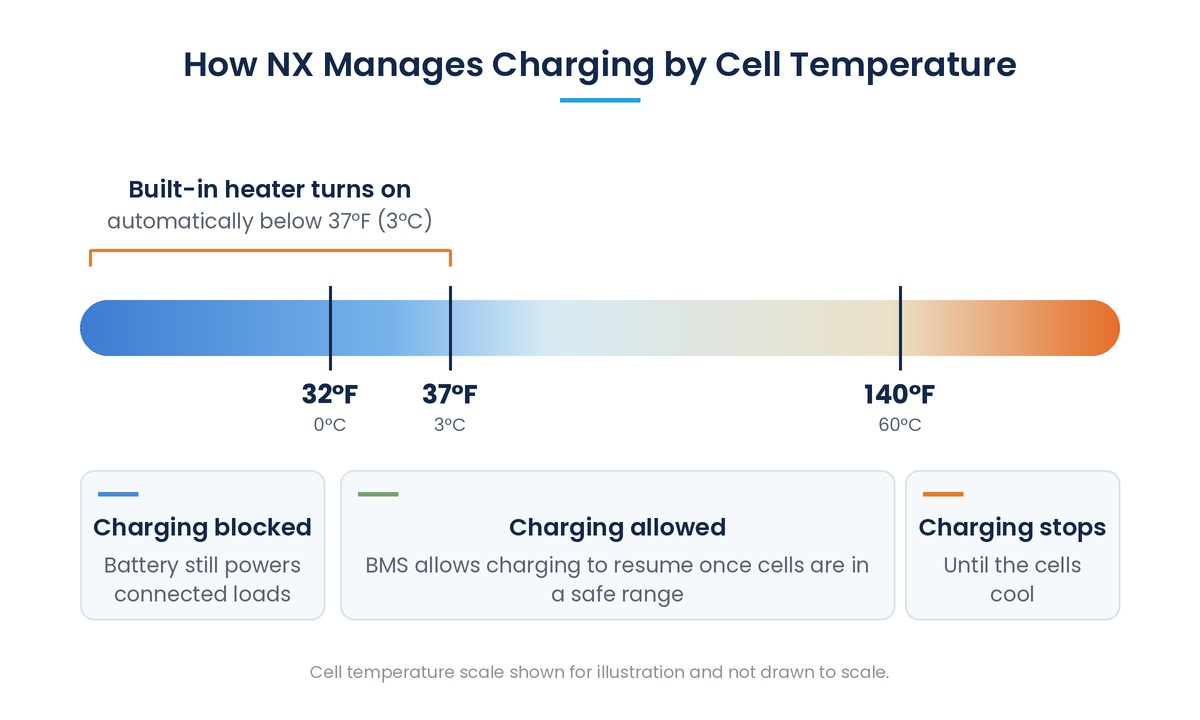
How NX manages charging by cell temperature: charging is blocked below 32°F (0°C), the built-in heater turns on below 37°F (3°C), and charging stops above 140°F (60°C) until the cells cool

The takeaway: NX continuously monitors operating conditions and helps manage battery performance through its integrated BMS.

The Muscle: How Does NX Manage High-Current Protection?

Modern electrical systems can place substantial demands on a battery, particularly when multiple devices operate at the same time. Meeting those demands requires more than the ability to deliver current. The battery must also manage that current and respond when operating conditions move outside its designed limits.

The NX12V310, the first model in the NX Series is rated for up to 300 amps of continuous discharge and 800 amps of peak output, supporting high-demand inverters and heavy electrical loads. In internal testing, the NX12V310 delivered sustained loads of 300A, 400A, and 500A, as well as peak loads up to 1,000A for five seconds, without damage. Maximum charge and discharge rates depend on ambient temperature and usage.

NX uses 175°C-rated MOSFET technology as part of its integrated electronic protection system. MOSFETs are electronic switches that control the flow of electricity. When the battery detects certain conditions outside its operating limits, its protection system can respond electronically. High-temperature-rated MOSFETs support the high-current switching requirements of the NX architecture.

The electronic protection system works alongside the BMS to help manage current and protect the battery during operation. NX incorporates both functions into a coordinated system, allowing monitoring and electronic protection to work together.

When electrical demand exceeds what the battery is designed to deliver, the BMS responds automatically. It continuously measures current, and if the current exceeds the configured limit, the BMS turns off the battery’s internal MOSFET switches. This interrupts output before the battery is pushed beyond its designed limits and alerts the user. In a short-circuit event, the BMS disconnects output when it detects the resulting voltage collapse.

Because this protection is built into the battery’s electronic switching, NX does not rely on an external circuit breaker for its own internal protection. Once the cause of the protection event has been corrected, output can be restored by pressing the power button.

For owners, this means the battery can interrupt power when necessary to protect itself and connected wiring and equipment from sustained overload. Power to connected equipment is interrupted during a protection event by design. Manufacturers and installers gain a battery designed to support high-current electrical demands while maintaining defined operating limits.

The takeaway: NX combines high-current capability with integrated electronic protection to help manage how power is delivered as electrical demands change.

The Connection: How Does NX Communicate With Other Equipment?

A battery is one part of a larger electrical system that may include an inverter, charger, solar equipment, or vehicle controls. As these systems become more sophisticated, communication between compatible components can provide better visibility into how the overall system is operating.

NX supports this communication through dual CAN connectivity. CAN, or Controller Area Network, is a communication technology that allows electronic components to exchange operating information. Through its CAN connections, NX can share battery information with compatible equipment and control systems.

NX uses RV-C, an open CAN-based communication standard widely used in recreational vehicles. On an RV-C network, NX broadcasts battery voltage, current, temperature, state of charge, state of health, and estimated time remaining. It also communicates its desired charging voltage and current to compatible chargers and inverter/chargers, allowing that equipment to adjust charging based on the battery’s needs rather than relying on fixed settings.

When the BMS needs to protect the battery, such as when it reaches full charge, approaches a temperature limit, or nears an empty state, it can first request that connected equipment stop charging or discharging. NX communicates these requests through both digital communications and analog signal outputs, directing a compatible charger to stop charging or an inverter to shed loads or stop.

If the connected equipment does not respond and continues operating, the BMS can open its internal charge or discharge circuit to protect the battery. This gives compatible equipment an opportunity to respond to the battery’s operating conditions before the battery disconnects the affected circuit.
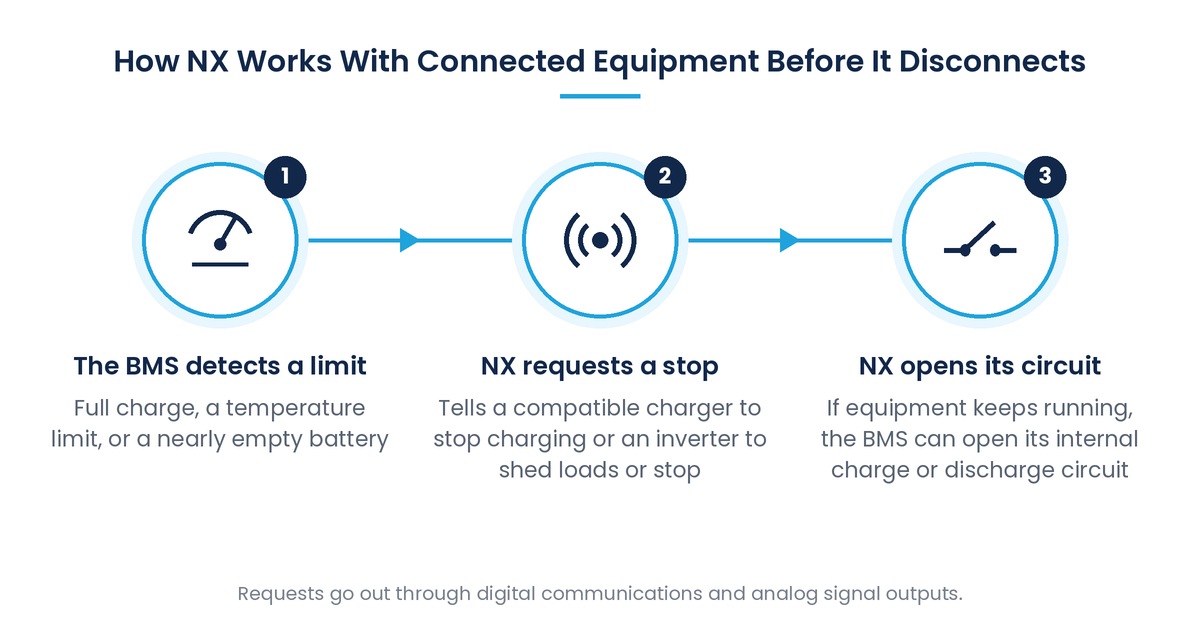
How NX works with connected equipment before it disconnects: the BMS detects a limit, NX requests a stop from the charger or inverter, then NX opens its internal charge or discharge circuit if equipment keeps running

NX’s second CAN port keeps the customer’s equipment network separate from the battery’s critical internal communication. This separation prevents third-party devices on the customer network from interfering with the battery’s internal protection functions.

The specific information exchanged and how it is used depend on the capabilities and configuration of the connected equipment. When supported, these communication functions allow charging and power equipment to respond to the battery’s operating conditions rather than operating without that information.

NX also includes Bluetooth connectivity, allowing owners and technicians to access battery information through the Lithionics mobile app. Users can view available operating information directly through the app rather than relying solely on external measurements or assumptions about battery conditions.

For manufacturers, these communication capabilities support integration with compatible electrical equipment. Owners and service technicians gain more direct access to battery information that can help with monitoring and troubleshooting.

The takeaway: Dual CAN communication and Bluetooth give compatible systems and users access to battery information, providing greater visibility into how the battery is operating.

How Battery Management, Protection, and Communication Work Together

Battery management, electronic protection, and communication serve different purposes within NX, but they are designed to operate together. The BMS continuously monitors conditions inside the battery, the electronic protection system helps manage current and respond to electrical faults, and CAN and Bluetooth communication make battery information available to compatible systems and users.

For owners, this means greater visibility into battery operation, with monitoring and protection functions built directly into the battery. Manufacturers and installers gain an integrated platform designed to work with increasingly sophisticated electrical systems.

The NX Series reflects Lithionics’ approach to battery development, bringing engineering, software, and electronic protection together in a single design. The platform is designed and engineered in the United States and built in Clearwater, Florida.

As power demands grow and electrical systems become more connected, the capabilities of a battery extend beyond how much energy it can store or deliver. How that energy is managed, protected, and communicated is becoming just as relevant to overall system performance.

Meet NX. More Than a Battery.

Explore the NX Series

Related Articles
Lithionics booth at IBEX 2026 in Tampa, Florida, showcasing lithium battery technology for marine applications

IBEX 2026 Recap: Smarter Marine Power, Innovation and What’s Next

Smarter electrical systems, advanced battery technology and reliable onboard power were major topics at this year’s International BoatBuilders’ Exhibition & Conference (IBEX).

Held October 6–8 in Tampa, Florida, IBEX 2026 brought the marine industry together to explore new technology, share ideas and talk about what’s next for boating.

For the Lithionics team, it was an opportunity to connect with boatbuilders, engineers and industry partners. We also had the chance to share our latest developments in lithium battery technology.

One thing stood out throughout the show: as boats become more capable, the electrical systems behind them are becoming more important than ever.

Marine Power Is About More Than the Battery

Today’s boats rely on electricity for much more than lights and navigation. Air conditioning, refrigeration, onboard electronics, communications and other equipment all place demands on the electrical system.

As those demands grow, boatbuilders need to think about more than simply adding battery capacity.

How efficiently can a system deliver power? How does it manage charging? What happens when electrical demands change? And how do the batteries, charging equipment and controls work together?

These are important questions as the marine industry looks for smarter ways to generate, store and manage power.

The focus is increasingly on complete electrical systems, not just individual components. The goal is to make onboard power easier to manage, more dependable and better suited to how people actually use their boats.

Smarter Charging and Better System Integration

One of the interesting developments at IBEX was the attention given to how boats generate, distribute and manage electricity.

The 2026 IBEX Innovation Awards recognized advances in alternator controls and modular power distribution. Both highlight the importance of better-connected electrical systems.

An alternator generates electricity while an engine is running. That electricity can support onboard equipment and recharge batteries. But charging a modern lithium battery system requires more than simply sending power into the battery.

Charging equipment, batteries and system controls need to work together. They also need to respond to changes in temperature, battery status and electrical demand.

When these components work together, boatbuilders and installers have greater control over how power moves throughout the vessel.

At Lithionics, this is an important part of our approach to intelligent lithium battery technology. Our battery management and communication capabilities are designed to support more connected, carefully managed electrical systems.

Because reliable power isn’t just about how much energy a battery can store. It’s also about how that energy is managed.

Battery Safety and Reliability Remain Essential

New technology brings exciting possibilities, but marine environments are demanding.

Boats experience vibration, moisture, temperature changes and changing electrical loads. Battery systems need to perform reliably in those conditions while supporting equipment owners depend on every day.

That’s why safety and engineering remain central to the conversation around lithium battery technology.

At Lithionics, safety is part of every stage of design and testing. That includes battery management, internal protection systems, enclosure construction and demanding mechanical testing.

Our approach includes system-level UL 1973 certification for applicable battery systems. We also conduct extensive testing to evaluate performance under challenging conditions.

For boatbuilders and marine professionals, that means greater confidence in the equipment they install and the power systems their customers depend on.

As onboard power requirements grow, that confidence becomes even more important.

Introducing the Next Generation of Intelligent Lithium Power

IBEX was also an opportunity to share what’s next at Lithionics, including our new NX Series battery platform.

NX is our next generation of intelligent lithium battery technology, bringing together higher power output, advanced battery management and communication capabilities designed for demanding applications.

The NX 12V310Ah battery delivers up to 300 amps of continuous discharge current. That means it can support electrical systems with higher power demands, including equipment that requires significant energy to operate.

But there’s more to NX than power output.

The platform combines high-current performance, intelligent protection and advanced communication features to help batteries work more effectively within a larger electrical system.

For marine OEMs, system designers and authorized installers, NX provides more flexibility to design integrated power systems around the needs of each application.

It’s an exciting step forward for Lithionics, and we’re looking forward to sharing more about what this technology can do.

Electrification Is Changing the Conversation

Another important theme at IBEX was the continued development of electric and hybrid marine technology.

The show’s Next-Gen Power & Performance Pavilion highlighted advances in electric propulsion, hybrid systems, battery storage and related technologies.

While fully electric boats often receive the most attention, electrification is a much broader conversation.

It’s also about how conventional boats use electricity, how onboard equipment is powered and how energy can be stored and managed more efficiently.

For example, a well-designed lithium house battery system can help power onboard equipment without needing to run a generator as often, depending on the vessel and system design.

This is one reason energy storage and intelligent power management are becoming increasingly important across the marine industry.

Every vessel has different requirements, but the need for dependable, well-integrated electrical power continues to grow.

Turning Innovation Into Real-World Solutions

One of the best parts of IBEX is connecting the people designing new technology with those putting it to work.

A new feature or specification is only part of the story. Boatbuilders and installers also need to understand how technology fits into an electrical system, performs in real conditions and benefits the end customer.

That practical perspective matters.

At Lithionics, we work with OEMs, authorized installers and integration partners across a wide range of marine applications. This includes projects with unique electrical requirements that call for more specialized power solutions.

Those relationships help connect engineering decisions to real-world needs. They also keep the focus on what matters most: delivering power people can depend on.

IBEX 2026: Looking Ahead to What’s Next

A big thank you to everyone who stopped by our booth, shared ideas and spent time with the Lithionics team at IBEX 2026.

From smarter charging and intelligent battery management to new possibilities for onboard power, there’s a lot to look forward to. We’re excited to keep working with our marine partners to turn these technologies into reliable, real-world solutions.

Until next year, IBEX!

Interested in learning more about Lithionics marine power solutions or our new NX Series? Connect with our team.

Firefly Takes to the Water: 403 kWh of Lithionics Power Onboard

After years of planning, engineering and collaboration, Firefly is officially on the water.

Lyman-Morse launched the 49-foot solar-electric catamaran from Thomaston, Maine, on August 3, 2026. Upstream Alliance will soon bring Firefly to the Delaware River, where the vessel will serve as a floating classroom, science laboratory and research platform.

Watch the Firefly launch video

Read the Lyman-Morse launch announcement


48 Batteries. 403 kWh. One Electric Vessel.

At the heart of Firefly sits one of the largest custom marine battery systems Lithionics has helped bring to life.

Forty-eight Lithionics 51V 165Ah lithium iron phosphate battery modules power the vessel’s propulsion system and deliver more than 403 kWh of onboard energy storage. Eight battery management systems provide control and redundancy, while two additional 24V Lithionics batteries support house power, including lighting, navigation and pumps.

The system also integrates 24 bifacial solar panels, 16 chargers and shore power, bringing solar generation, lithium battery storage and electric propulsion together in one complete marine power system.

Explore the 51V 165Ah Lithionics battery module


Built for More Than Transportation

Firefly goes beyond electric propulsion.

Upstream Alliance created the vessel to give students hands-on opportunities to study water quality, conduct research and explore the Delaware River ecosystem. Each trip can welcome up to 32 students, turning the vessel into a floating classroom for environmental science, sustainability and STEM education.

The technology powering Firefly becomes part of that experience. Students won’t just learn about clean energy in a classroom. They’ll experience it firsthand on a vessel powered by solar generation and high-capacity lithium battery storage.

Follow Firefly’s delivery journey with Upstream Alliance


Engineering for the Mission

Firefly brings energy storage, electric propulsion, solar charging, onboard power and safety together in one integrated system designed to meet U.S. Coast Guard Subchapter T requirements.

The project brought together Upstream Alliance, Lyman-Morse, Gerr Marine, OceanPlanet Energy, Lithionics Battery and other technology partners to turn the concept into a working vessel.

Firefly demonstrates what high-capacity lithium battery systems can deliver when engineers build around the demands of a real-world marine application.

49 feet. 48 Lithionics batteries. More than 403 kWh of stored energy. And one very different kind of classroom.

Explore the Lithionics Firefly Battery System


Marine Lithium Battery Systems for Boats and Yachts: The Future of Marine Power

Modern Boats Require a New Approach to Energy Storage

Today’s boats and yacht builders incorporate more advanced electrical systems than ever before.

Modern vessels rely on onboard electrical systems to support navigation, refrigeration, climate control, entertainment, communications, stabilization systems, and offshore operations. As electrical demand continues to increase, modern vessels push traditional battery technology to its limits.

For decades, AGM and flooded lead-acid batteries have been dependable solutions for marine applications. However, many were not designed for the continuous high-energy demands of modern vessels.

This is why more builders, OEMs, dealers, and owners are moving toward integrated marine lithium battery systems based on lithium iron phosphate (LiFePO₄) technology.

Unlike a simple battery replacement, a marine lithium upgrade represents a shift toward a smarter, more efficient electrical engineering.


Safety and Certifications

Safety is the foundation of Lithionics system design.

Every Lithionics lithium-ion battery system is UL 1973 Listed as a complete system, not simply validated at the cell level. This certification confirms that the battery, electronics, and protective systems operate safely together under real operating conditions.

Lithionics systems also incorporate Lithium Iron Phosphate (LiFePO4) chemistry, selected for its thermal stability, long cycle life, and durability in mobile applications.

Together, these design choices create a battery platform engineered for long-term safety and consistent performance.


What is a Marine Lithium Battery System?

A marine lithium battery system is an integrated energy storage solution designed specifically for boats and yachts using lithium iron phosphate (LiFePO₄) battery chemistry.

A complete marine lithium system combines:

  • LiFePO₄ battery cells for efficient energy storage
  • Battery Management System (BMS) protection
  • Marine-grade enclosure design
  • Charging system compatibility
  • Battery monitoring and diagnostics

The result is more than a battery bank. It is a managed electrical platform designed to provide reliable power in demanding marine environments.

Modern vessels require energy storage systems that can support higher electrical loads while maintaining safety, efficiency, and long-term reliability.


Builders Shift from AGM to Lithium Solutions

The transition from AGM batteries to lithium is being driven by the increasing electrical complexity of modern boats.

Today’s vessels may need to power:

  • Air conditioning
  • Refrigeration
  • Navigation equipment
  • Entertainment systems
  • Gyro stabilizers
  • Communication systems
  • Advanced onboard electronics

Traditional lead-acid batteries can support many applications, but they have limitations when vessels require extended runtime, faster charging, and greater usable energy.


5 Advantages of LiFePO4 Marine Battery Systems

#1 More Usable Energy from the Same Footprint

Unlike AGM batteries, which are typically limited to about 50% usable capacity to maximize service life, LiFePO₄ batteries allow you to use nearly all of their rated capacity. That means longer runtime without increasing the size of your battery bank.

Example:

Battery Rated Capacity Typical Usable Capacity
2 x 12V 100Ah AGM Batteries 200 Ah ~100 Ah
1 x Lithionics 12V 205Ah 205 Ah Up to 205 Ah

What does that mean?

A single Lithionics 12V 205Ah LiFePO₄ battery can provide up to twice the usable energy of two 12V 100Ah AGM batteries.

  • Up to 2× more usable energy
  • 50% fewer batteries
  • Reduced weight and installation space
  • Longer runtime for electronics, refrigeration, lighting, and other onboard DC loads

Instead of carrying extra batteries just to avoid over-discharging an AGM bank, a LiFePO₄ system lets you use nearly all of the energy you’ve already installed.


#2 Faster Charging

LiFePO₄ batteries can accept significantly higher charging currents than AGM batteries, allowing them to recharge more quickly when paired with a compatible charging system. This means less time running generators or waiting at the dock.

What does that mean?

Whether you’re charging from shore power, an alternator, or a generator, a properly integrated LiFePO₄ system can spend more time charging at its maximum rate and less time tapering as the battery fills.

Benefits:

  • Reduced generator runtime
  • Faster recovery between trips
  • More time enjoying your boat
  • Improved charging efficiency

#3 Less Weight and More Space

LiFePO₄ batteries store more energy in less space than traditional AGM batteries. By reducing the number of batteries needed, many vessels can free up valuable room while significantly reducing overall battery-bank weight.

What does that mean?

Replacing multiple AGM batteries with fewer LiFePO₄ batteries can simplify installation while reducing weight that affects vessel performance and storage space.

Benefits:

  • Smaller battery bank
  • Reduced overall weight
  • More available storage space
  • Simplified installation

#4 Longer Service Life

LiFePO₄ batteries are designed for thousands of charge and discharge cycles, making them well suited for vessels that spend long days on the water or operate year-round.

What does that mean?

While AGM batteries gradually lose capacity with repeated cycling, LiFePO₄ batteries are engineered to maintain reliable performance through many more charging cycles, helping reduce battery replacements over time.

Benefits:

  • Thousands of charge cycles
  • Fewer battery replacements
  • Lower long-term ownership costs
  • Reliable performance year after year

#5 Built for Marine Reliability

A marine lithium battery system is more than a battery—it’s an intelligently managed energy system. Integrated Battery Management Systems (BMS) continuously monitor battery health and help protect the system during charging and operation.

What does that mean?

Rather than relying solely on the battery itself, a LiFePO₄ system actively monitors voltage, current, temperature, and overall battery health to help maintain safe, reliable operation.

Benefits:

  • Continuous system monitoring
  • Intelligent battery protection
  • Real-time battery information
  • Greater confidence on the water

Are Lithium Batteries Safe on Boats?

One of the most common questions among boat owners and builders is:

Are lithium batteries safe on boats?

The answer is yes—when they’re designed as a complete marine battery system.

Safety depends on far more than battery chemistry alone. A reliable marine lithium system combines LiFePO₄ battery cells, an intelligent Battery Management System (BMS), compatible charging equipment, mechanical protection, and proper installation.

Because marine environments expose batteries to vibration, shock, humidity, salt, and temperature changes, purpose-built marine lithium systems are engineered specifically to operate in these demanding conditions.

Engineering Safety Into the System

“Marine lithium safety isn’t defined by the battery alone. It comes from designing every component—from the battery and BMS to the charging system—to work together as one integrated electrical system.”
— William Cavanuagh, VP of Engineering

A properly engineered marine lithium battery system continuously monitors battery health and operating conditions while helping protect the system throughout the life of the vessel.


Why Marine Lithium Systems Are Built Differently

Not all lithium batteries are designed for marine applications.

Boats operate in challenging environments where batteries are exposed to:

  • Continuous vibration
  • Wave impact
  • Humidity
  • Salt exposure
  • Limited access for maintenance

Purpose-built marine lithium systems are engineered to perform reliably under these real-world conditions.

Marine-Grade Protection

A robust enclosure helps protect the battery system from the physical demands of life on the water.

Premium marine lithium systems are designed with:

  • Corrosion-resistant materials
  • Structural protection
  • Environmental durability
  • Long-term reliability

These design features help protect the battery throughout years of operation in harsh marine environments.

Intelligent Battery Management

The Battery Management System (BMS) serves as the intelligence behind the battery system.

It continuously monitors:

  • Voltage
  • Current
  • Temperature
  • Battery health

This allows the system to operate within safe performance limits while providing real-time visibility into battery health and performance.


Is a Lithium Upgrade Just a Battery Replacement?

No.

An AGM to lithium conversion is more than simply removing old batteries and installing new ones. A successful marine lithium upgrade requires evaluating the vessel’s complete electrical system to ensure the batteries, charging equipment, and onboard systems work together.

Important considerations include:

  • Charging equipment compatibility
  • Alternator capability
  • Inverter and shore-power systems
  • Battery monitoring
  • Installation design

Lithium technology delivers its greatest benefits when every component works together as a complete electrical system.


The Future of Marine Electrical Systems

As boats become more electrically sophisticated, energy storage is no longer simply a battery selection—it’s a system design decision.

The next generation of marine power will deliver:

  • Greater efficiency
  • Faster charging
  • Intelligent monitoring
  • Reduced generator dependence
  • Improved offshore reliability

Integrated marine lithium battery systems are already helping shape this future by providing vessels with smarter, more capable, and more dependable electrical platforms.


Ready to Upgrade Your Boat’s Electrical System?

Whether you are replacing aging AGM batteries, planning an AGM to lithium conversion, or designing a new vessel electrical system, Lithionics can help you engineer the right marine lithium solution.

Every vessel has different power requirements. Our team can help determine the ideal battery configuration, charging requirements, and system design for your application.

Request a Lithionics marine lithium battery quote today: Connect with our Sales Engineers.


Frequently Asked Questions

What is a marine lithium battery system?

A marine lithium battery system integrates LiFePO₄ batteries, battery management, charging compatibility, and monitoring into a single energy storage platform built specifically for boats and yachts.

Can lithium batteries replace AGM batteries on boats?

Yes—but replacing AGM batteries with lithium should include evaluating the vessel’s complete electrical system to ensure charging equipment, alternators, and onboard electronics are compatible.

Are LiFePO₄ batteries safe for marine use?

Yes. When properly engineered and installed, LiFePO₄ marine battery systems provide reliable performance through integrated protection, intelligent monitoring, and complete system design.

Do lithium batteries work in saltwater environments?

Yes. Engineers build marine lithium systems to withstand challenging conditions such as vibration, humidity, and salt exposure when properly installed and maintained.

Can lithium batteries reduce generator runtime?

Yes. In many applications, faster charging capability and higher usable energy can reduce generator runtime while improving overall onboard efficiency.