
Your battery never works alone.
On a boat anchored for the weekend, the battery runs the inverter that keeps the air conditioning, refrigeration, and navigation electronics going.
On a service truck, the battery runs the inverter for power tools and lights, then has to start the air compressor the moment the crew needs it, with the engine off and no time to troubleshoot.
For an RV that’s someone’s full-time home, the refrigerator, furnace fan, and air conditioning cycle on and off day and night, and the battery has to carry every one of those loads, with no time off.
Each one asks something different of the battery, and in each one, the battery is only one part of the system.
So what does it take to design a battery for that? You start with the whole system, not just the battery.
That’s how Lithionics approached the NX Series. By understanding how batteries interact with power generation, charging, conversion, and connected equipment, Lithionics engineers designed NX around the demands of the complete electrical system. Customer experiences, service insights, and manufacturer integration challenges helped shape three engineering priorities:
- The demand: Deliver power through sustained loads and brief spikes in current.
- The conditions: Account for movement and changing temperatures.
- The integration: Exchange useful information with compatible chargers, inverters, and controls.
How does sustained power demand affect lithium battery design?
Sustained electrical loads affect how a battery’s current-handling components and thermal behavior are designed. The Lithionics NX Series is built for both equipment that runs for extended periods and the brief surges that happen when that equipment starts. The NX12V310 is rated for up to 300 amps of continuous discharge and 800 amps of peak output. Maximum charge and discharge rates depend on ambient temperature and usage.
Some RV owners never switch off their electrical systems. They live in their vehicles full-time, so the battery isn’t supporting occasional weekend use; it’s part of their everyday power supply.
On a work truck, the operator isn’t interested in checking screens before starting a compressor. They need to press a button and get on with the job. A failed start can interrupt the workday.
Marine customers have another set of priorities. Away from shore power, batteries and inverters supply electricity for onboard systems, from refrigeration to air conditioning. Offshore, an electrical problem is harder to address.
Why does the startup load matter? Equipment such as an air conditioner can draw more current when starting than when running steadily. The battery, inverter, and wiring all have to be specified for the loads involved.
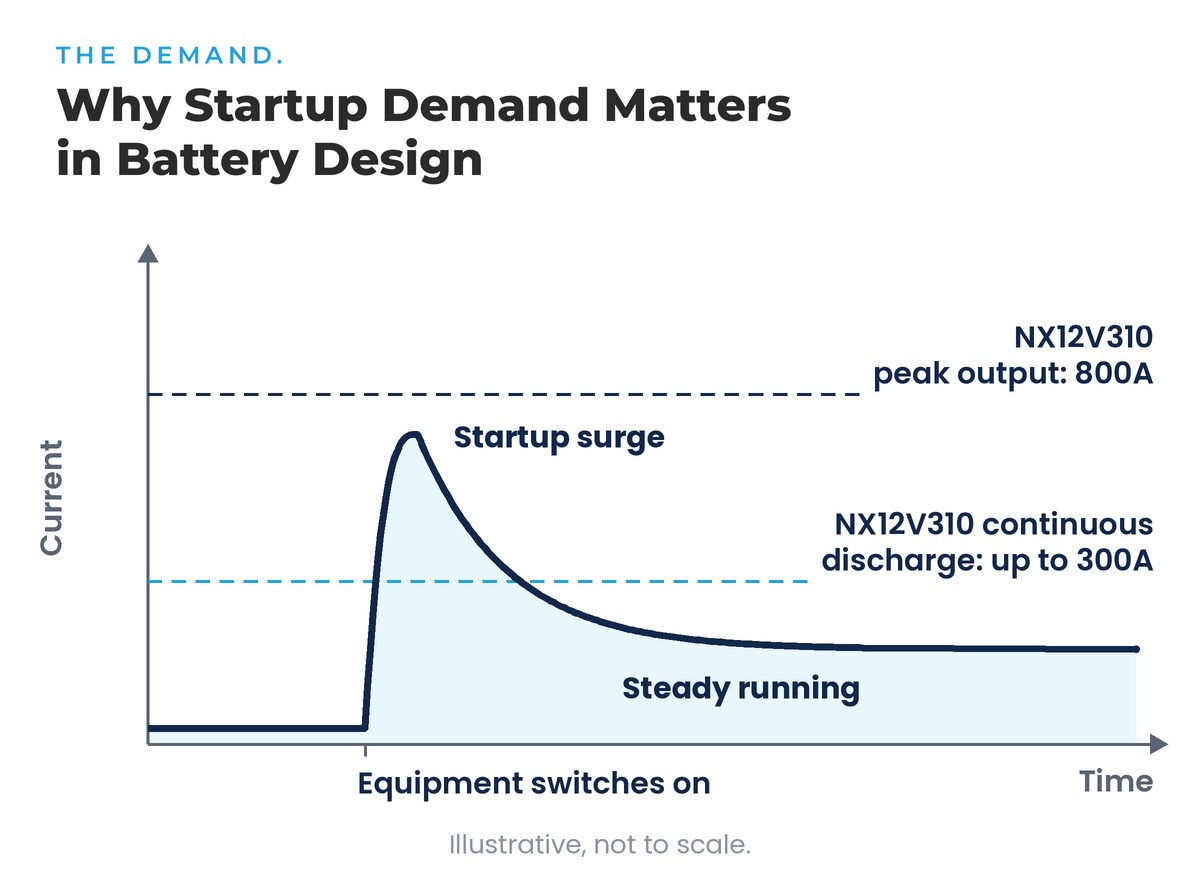
Heat management is a central part of NX development. Electrical resistance creates heat as current moves through the battery. NX uses 175°C-rated MOSFETs, electronic switches that control the flow of electricity, as part of its integrated electronic protection system. These high-temperature-rated switches support the high-current demands of the NX architecture.
The takeaway: NX is built to handle sustained loads, short current surges, and the heat they create.
How do operating conditions influence the design of NX?
A lithium battery has to function within defined electrical and temperature limits while its surroundings change. NX monitors operating conditions through its integrated Battery Management System (BMS), with charging protections for low and high temperatures. It also has to hold up to the movement of the vehicle it’s installed in.
A battery riding in a work truck over rough pavement experiences constant movement and vibration. Every bump affects the components inside the battery enclosure, including electrical connections that have to withstand those conditions over time.
Temperature introduces another set of requirements. NX includes built-in charging protections for both cold and hot conditions:
- Below 32°F (0°C): The BMS blocks charging while the battery remains available for connected loads.
- Below 37°F (3°C): The integrated heater activates to warm the cells.
- Above 140°F (60°C): Charging stops until the cells cool to an appropriate range.
The takeaway: NX design accounts for movement and temperature, not only the moments when the battery is delivering full power.
How does NX work with inverters, chargers, and other equipment?
The Lithionics NX Series shares battery operating information with compatible equipment through CAN, or Controller Area Network, a communication technology that allows electronic components to exchange operating information. The NX12V310 has dual CAN ports and supports RV-C, an open CAN-based communication standard widely used in recreational vehicles. It also offers Bluetooth access through the Lithionics mobile app. These connections give owners and installers greater visibility into battery conditions and help compatible equipment coordinate charging and power delivery.
Many electrical system problems don’t originate inside the battery. They come from how the battery interacts with inverters, chargers, and other components. NX shares its operating information with that equipment, so compatible chargers can adjust to the battery’s needs rather than relying on fixed settings.
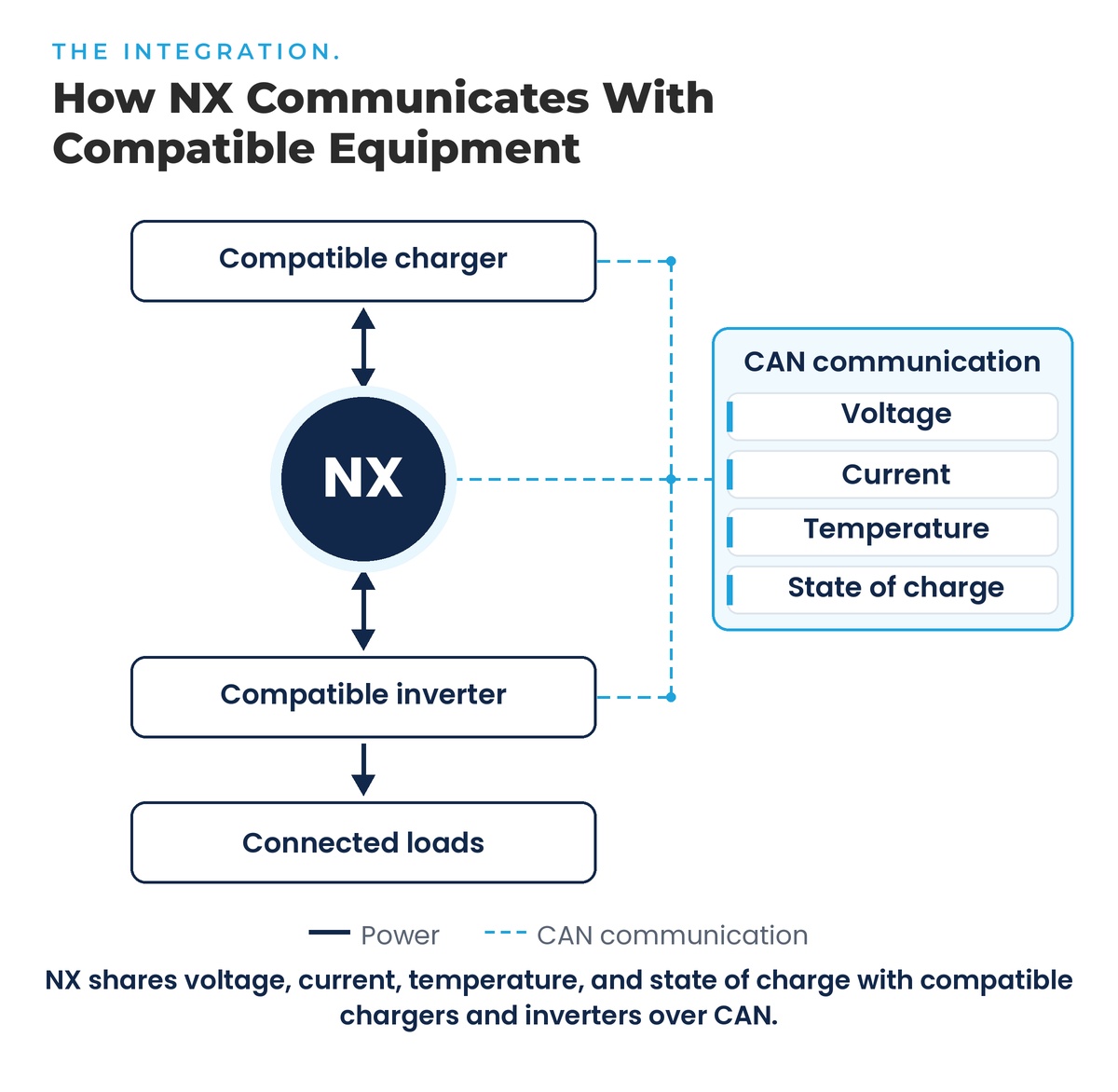
How and what does NX communicate? Through its integrated electronics, NX can:
- Share voltage, current, temperature, and state-of-charge information over RV-C with compatible equipment.
- Communicate desired charging voltage and current to supported chargers and inverter/chargers.
- Use its second CAN port to keep the customer equipment network separate from internal battery communication.
- Give owners and technicians access to battery information through the Bluetooth mobile app.
Marine installations show why integration deserves so much attention. A boat’s batteries, inverter, alternator, and shore power connections all have to work together. When you’re offshore or heading back to port, an electrical shutdown can mean losing power to navigation equipment and instruments.
For owners, having access to battery information makes it easier to understand operating conditions and investigate problems. For OEMs and installers, NX provides communication capabilities they can account for when designing and integrating the complete electrical system.
The takeaway: NX is designed to communicate with compatible equipment, giving owners, technicians, and manufacturers the information they need to understand battery operation and better coordinate the larger power system.
What does the NX12V310 bring to a complete power system?
NX brings high-current output, electronic protection, temperature-based charging controls, and digital communication together in one battery platform. These capabilities help meet the demands of RVs, work trucks, marine applications, and specialty vehicles, where dependable power requires the battery, charging equipment, and connected systems to work together.
NX12V310 at a glance
- Continuous discharge: Up to 300A
- Peak output: 800A
- Electronic switching: 175°C-rated MOSFET technology
- Cold-weather charging: Blocked below 32°F (0°C)
- Cell heating: Activates below 37°F (3°C)
- High-temperature charging: Stops above 140°F (60°C)
- System communication: Dual CAN, including RV-C data
- Owner and technician access: Bluetooth through the Lithionics mobile app
Each application brings different operating conditions and expectations. Understanding those differences helps manufacturers choose the right equipment, plan installations, and account for the demands their customers place on the electrical system.
Designed and engineered in the United States and built in Largo, Florida, NX reflects Lithionics’ approach to developing battery technology around the way people actually use power.
The takeaway: NX gives owners, manufacturers, and installers a battery platform designed with the needs of the complete electrical system in mind.
NX. Engineered for the Whole System.
For a closer look at the technology inside NX, read Inside NX: What Makes a Lithium Battery Truly Intelligent?
FAQ: What should owners and manufacturers know about NX?
The Lithionics NX12V310 combines high-current capability, integrated protection, and communication features for demanding electrical applications. Here are answers to common questions about its operation and integration with other equipment.
Can the NX12V310 support sustained electrical loads?
The NX12V310 is rated for up to 300A of continuous discharge and 800A of peak output. The battery, inverter, and other electrical components must be properly matched to the equipment’s continuous and startup power requirements.
What happens if NX is charged in freezing temperatures?
The Battery Management System (BMS) blocks charging below 32°F (0°C), while the integrated heater activates below 37°F (3°C) to warm the cells. Charging resumes when cell temperatures return to the permitted range.
Why does system integration matter for marine battery installations?
Marine electrical systems often combine batteries, inverters, alternators, and shore power. Those components need to operate together, particularly when a boat is offshore and the crew depends on onboard electrical equipment for navigation and other functions.
What should OEMs and installers check when integrating NX?
Original equipment manufacturers (OEMs) and installers should evaluate continuous and startup loads, charging requirements, wiring, operating conditions, and equipment compatibility. NX supports CAN communication, but connected equipment must support the relevant communication functions.
How can owners monitor the NX battery?
Owners can access battery operating information through the Lithionics mobile app using Bluetooth. NX also shares operating data with compatible equipment through RV-C, the CAN-based communication standard widely used in recreational vehicles.


